
IT Solutions since 2009
IT Consulting Lucke – founded in 2009 as a sideline next to the business informatics studies – has been serving customers in the SME sector as well as private customers in the field of information processing, social media, e-commerce and SEO as well as many other areas for 14 years now.
Founder and company owner Sascha Lucke had his first contact with information processing technology at the age of 9 and has since been intensively involved with problems and their solutions in the information processing sector.
Common goals
We always consider one thing very important: the satisfaction of our customers.
But how do you achieve satisfied customers:
The very first thing is to listen carefully. An analysis of the actual situation forms an important basis for this.
On the basis of our customers’ wishes, we develop problem-solving proposals, which are then refined in further discussions with the customers.
We also consider it a decisive advantage that many sub-areas are handled in-house. This keeps communication channels short and fast and costs low. For example, web design and photo design work/product photography usually go hand in hand. Thus, adjustments and further development are possible quickly and easily.
In the area of our services we go into more detail about the different areas of our service spectrum.
Our strong partners
You often hear “everything from a single source“, but what can really come from a single source?
Whereas, as an example, outsourcing has been written large everywhere for years.
With our core competencies, we provide a solid basis for a solution to the problem, which should cover all needs and thus be all-encompassing and holistic.
But you can’t do everything yourself, right?
That’s exactly why we have strong partners and products at our side, which we have selected carefully and for the long term.







 https://itc-lucke.com/wp-content/uploads/2026/10/Sodola-Switch-vor-Grafana-Dashboard-1.png
770
2041
SaschaITC257
https://itc-lucke.com/wp-content/uploads/2021/08/Logo.png
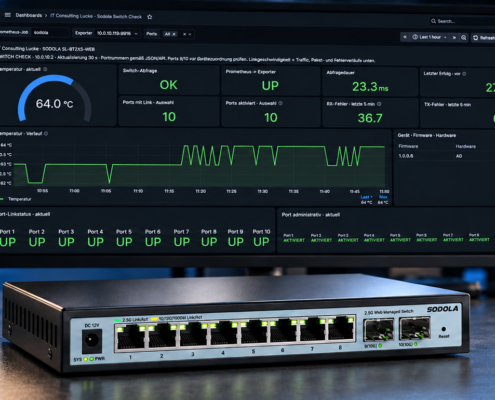
SaschaITC2572026-10-01 22:23:192026-10-01 22:28:32From Web Interface to Monitoring: A Custom Prometheus Exporter for the Sodola Switch
https://itc-lucke.com/wp-content/uploads/2026/10/Sodola-Switch-vor-Grafana-Dashboard-1.png
770
2041
SaschaITC257
https://itc-lucke.com/wp-content/uploads/2021/08/Logo.png
SaschaITC2572026-10-01 22:23:192026-10-01 22:28:32From Web Interface to Monitoring: A Custom Prometheus Exporter for the Sodola Switch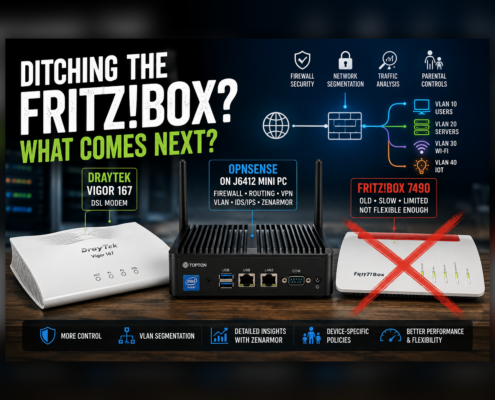 https://itc-lucke.com/wp-content/uploads/2026/08/ditch-the-fritzbox-preview-EN-1652x1340-1.png
1340
1652
SaschaITC257
https://itc-lucke.com/wp-content/uploads/2021/08/Logo.png
SaschaITC2572026-08-11 18:02:052026-08-11 18:08:44Getting Rid of the Fritzbox – What Comes Next?
https://itc-lucke.com/wp-content/uploads/2026/08/ditch-the-fritzbox-preview-EN-1652x1340-1.png
1340
1652
SaschaITC257
https://itc-lucke.com/wp-content/uploads/2021/08/Logo.png
SaschaITC2572026-08-11 18:02:052026-08-11 18:08:44Getting Rid of the Fritzbox – What Comes Next? https://itc-lucke.com/wp-content/uploads/2026/06/saschi-gen8.png
1086
1448
SaschaITC257
https://itc-lucke.com/wp-content/uploads/2021/08/Logo.png
SaschaITC2572026-06-09 16:21:202026-06-09 16:31:25HP MicroServer Gen8: Boot TrueNAS from an SSD on the ODD Port using a GRUB USB Bootloader
https://itc-lucke.com/wp-content/uploads/2026/06/saschi-gen8.png
1086
1448
SaschaITC257
https://itc-lucke.com/wp-content/uploads/2021/08/Logo.png
SaschaITC2572026-06-09 16:21:202026-06-09 16:31:25HP MicroServer Gen8: Boot TrueNAS from an SSD on the ODD Port using a GRUB USB Bootloader


